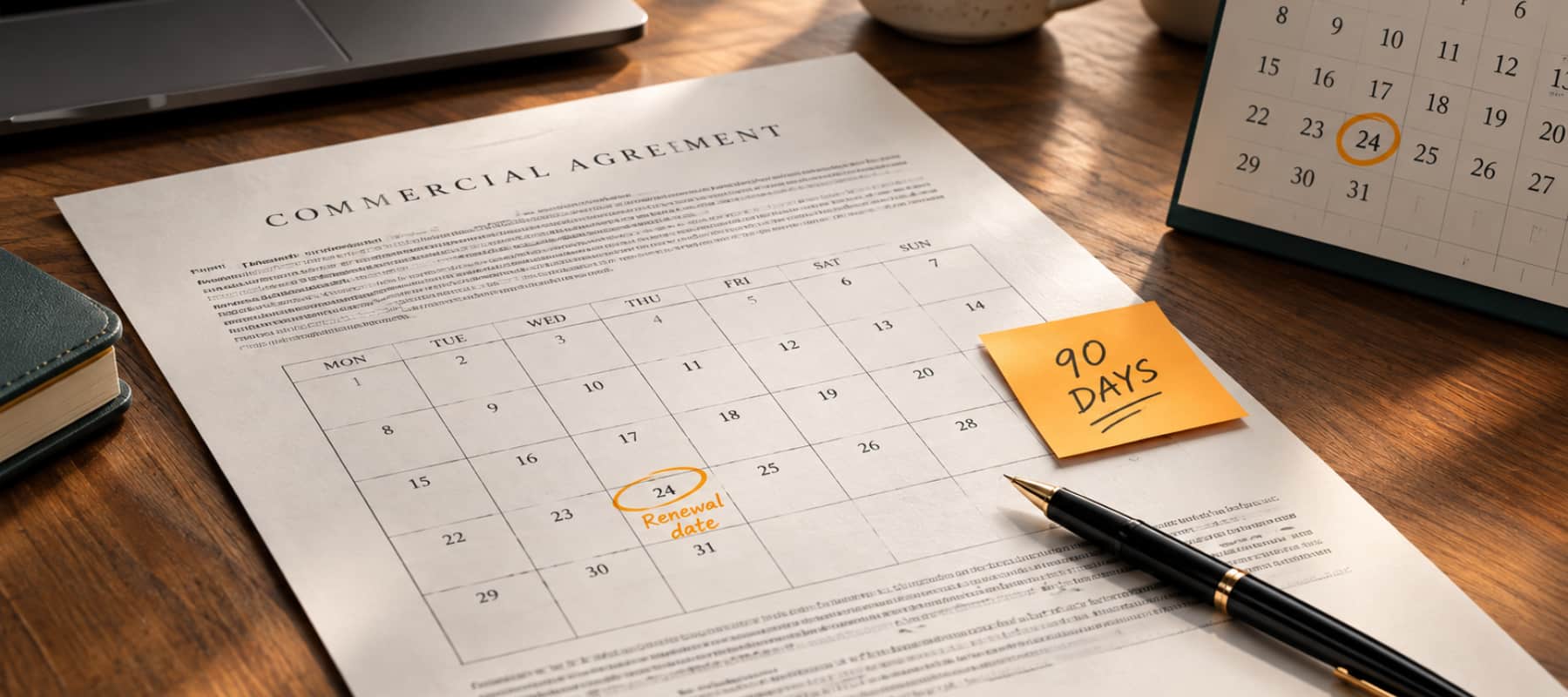
Many businesses may assume that when a contract reaches the end of its term, they will have an opportunity to decide whether to continue the relationship. In practice, that is not always what happens. Contracts frequently renew automatically, notice periods are missed and long-standing commercial arrangements continue for years without anyone pausing to consider whether the agreement still works for the business.
Contract renewal management is the discipline of ensuring that commercial agreements are tracked, reviewed and consciously acted upon before their expiry dates arrive. Done well, it is a source of genuine commercial advantage. Without it, businesses carry financial, operational and legal exposure that is almost always avoidable.
The problem with letting contracts run
The most immediate risk is automatic renewal. Many commercial agreements include clauses that expressly provide for the contract to roll over into a new term unless one party serves written notice of termination within a defined window, typically 30, 60 or 90 days before expiry. Missing that window is not simply a lost negotiating opportunity. It creates a binding commitment to another full term, potentially at pricing or on conditions that no longer present good value or reflect what the business needs.
Beyond the mechanics of auto-renewal lies a more gradual problem. A contract signed three or four years ago reflected the priorities, risk appetite and commercial assumptions of that moment and those things change. The business may have grown or shifted direction. The other party’s performance may have disappointed. The pricing that seemed reasonable at signing may look quite different set against what the current market conditions. A structured renewal process gives the business a defined moment to take stock. Without one, the relationship simply continues on its existing terms and the leverage that the renewal conversation would have provided disappears without anyone noticing.
There is also a risk that tends to receive less attention than it deserves: contractual drift. Over time, relationships develop in ways that the original agreement does not anticipate. Additional services get added informally, pricing arrangements evolve through verbal agreements, responsibilities shift between teams and operational workarounds become standard practice. Through all of that, the underlying contract often remains untouched, still reflecting the position the parties took at the outset rather than how the relationship has operated. When a disagreement eventually surfaces, businesses can find that the written agreement and the commercial reality have diverged considerably, leaving both parties exposed in ways neither had foreseen.
Compliance is the dimension that most often catches businesses off guard. Legal and regulatory requirements do not stand still and an agreement that was perfectly adequate when it was signed may no longer satisfy current requirements. A supplier agreement drafted several years ago may contain data protection provisions that no longer reflect current practices or regulatory expectations. Liability provisions may not align with the cyber risks that businesses now routinely face. In regulated sectors, specific obligations may have changed significantly since the agreement was signed, leaving businesses technically non-compliant under contracts they have not looked at since the ink dried. Renewals are the natural point at which to bring agreements into line with the current legal and regulatory environment, but only if someone is actively looking for those gaps.
Why it tends to go wrong
In most businesses, contracts are scattered across email threads, shared drives, filing systems and the institutional memory of people who may since have moved on. There is often no single repository where anyone necessary can see clearly what agreements the organisation is currently operating under, when they expire and what notice obligations attach to each one. In that environment, renewals become reactive by default, with someone spotting a deadline when it is almost upon them, a decision being rushed and any meaningful opportunity to negotiate already gone.
Spreadsheets and calendar reminders are the standard response to that problem and they function well enough at small scale. The difficulty is that they do not grow well. As the volume of active contracts increases, manual tracking becomes progressively less reliable. Entries fall out of date, reminders are missed and the overall picture is not complete enough to trust when it matters most.
Accountability is the other consistent weakness. Even in well-organised businesses, the question of who owns a renewal decision is often unclear. Legal may hold the document, procurement may manage the vendor relationship, finance may have the strongest interest in the cost outcome and the business unit using the service may be the only team who can say whether it has delivered value. Without clear ownership, the renewal drifts between functions, each assuming someone else has it in hand.
What good contract management looks like
The foundation is a centralised contract register that captures the key commercial and legal terms of every active agreement: the parties, the contractual term, any automatic renewal provisions, the applicable notice period and the individual (or team) responsible for managing the relationship. This does not require sophisticated technology, though technology can help considerably at scale. What it requires is completeness, currency and the discipline to consult it. A register that is out of date or routinely ignored provides no meaningful protection.
Reviews must be triggered well in advance of expiry. A lead time of 90 to 120 days before expiry is a reasonable baseline for most commercial contracts (though it will vary from one to another), providing time to evaluate the relationship properly, decide whether terms need to change, prepare a negotiating position where that is warranted and serve any required notice if the decision is to exit. For high-value or strategically significant agreements, that window should be extended accordingly.
The review itself should go further than confirming whether to continue. It should ask whether:
- the other party has performed as the contract required
- the pricing remains competitive
- the scope of the agreement still reflects what the business actually needs
- regulatory or compliance developments need to be reflected in the renewed terms.
It should also ask whether the written contract still accurately reflects how the relationship has operated in practice, or whether drift has created a gap that needs to be addressed before the next term begins. In practice, a renewal is a negotiation, even where both parties anticipate continuing on broadly similar terms. Treating it as one is how businesses extract genuine value from the process rather than simply carrying the status quo forward.
Supplier performance and leverage deserve particular attention at this stage. Businesses that arrive at a renewal conversation with a clear picture of what has and has not been delivered are in a considerably stronger position than those who simply accept the terms on offer. Where an incumbent supplier has underperformed, if that has not previously been addressed, the renewal is an appropriate moment to do so, whether through revised service levels, adjusted pricing or more robust contractual protections going forward. That leverage exists only briefly and only if the business is prepared to use it.
Involving the right people at the right stage matters too. The person managing the day-to-day relationship holds information about performance and reliability that legal or procurement simply will not have. Finance has a view on spend and budget constraints that should shape any conversation about pricing. Legal can identify terms that have created difficulty or carry ongoing risk. Bringing those perspectives together early enough to be truly useful, rather than at the last moment when options are already narrowing, is what distinguishes a thorough renewal process from a formality.
For businesses carrying a significant volume of contracts, contract lifecycle management software can make a material difference to the reliability of the whole process, providing automated alerts, a searchable central repository and structured workflows that reduce dependence on individual memory and manual administration. The practical question is whether the volume and value of contracts justifies the investment and for many businesses of even moderate size the answer is that it does.
The practical steps worth taking now
For businesses without a structured contract management process, the sensible starting point is understanding exactly what obligations they are already committed to. That means identifying every active commercial agreement, mapping the relevant expiry and notice dates, and assigning clear responsibility for each one. A spreadsheet built on that basis, kept current and properly used, is a meaningful improvement over the absence of any system.
From there, building a renewal calendar with realistic lead times and a consistent review process transforms renewals from administrative emergencies into deliberate commercial decisions. Standardising the questions asked at each review and the way decisions are recorded, makes the approach more robust over time and less dependent on any one individual carrying the institutional knowledge in their head.
It is also worth examining how existing agreements are drafted, particularly around automatic renewal and notice provisions. Understanding precisely what each contract commits the business to and when those obligations arise, is the basic prerequisite for managing them competently. Where there is uncertainty about what a contract requires, that uncertainty is worth resolving now rather than allowing it to sit until a deadline forces the issue.
Getting legal advice at the right time
Contract management is fundamentally a business process, but there are moments in the renewal cycle where specialist legal input makes a significant difference to the outcome. Reviewing the terms of a significant renewal, assessing whether performance failures give grounds for renegotiation or early termination, updating template agreements to reflect changes in the law or resolving a dispute that has emerged at the end of a term are all situations where experienced advice protects the business and improves the commercial result.
Buckles’ corporate and commercial team works with businesses across a range of sectors on the review of commercial agreements, renewal strategy and ensuring that contracts continue to reflect the relationships they are intended to govern. If you would like to discuss your approach to contract management, we would be glad to help.